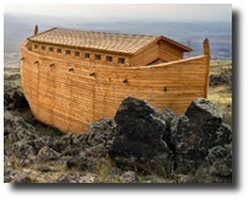

Sometimes when you hear the question, “What’s wrong with this picture?”, you are supposed to direct your attention to an actual picture in order to analyze it closely to see what is subtly out-of-place. In this case, I am not referring to the graphic on this page but to the scenario I’m about to paint for you.
I am often asked if I ever speak in public schools. My response is that I occasionally have the opportunity, but it’s always at the invitation of some Christian group on campus. (There was one exception a number of years ago where I was invited by the school administration to address the students, but that’s a story for another time.) The motivation of most people asking me this question is they believe we really need to change what the schools are teaching our kids.
Picture
At a minimum we need to give students another view to consider, even if we can’t stop schools from conveying all the falsehoods currently being taught as truth. People often feel this would be the most important thing we can do to help our youth who are being led astray, which has grave effects on their well-being and consequently on society in general.
There are a number of things “wrong with this picture”. I will list a few and focus on one.
First of all, even if we could somehow change the laws so that a defense of the Christian worldview could be presented in public schools, the next set of legislators who are elected could easily reverse the ruling, and we’d be back to square one.
Secondly, for the most part, you would be requiring non-Christian teachers to present the information, and you would have to wonder how good of a job they would do presenting something they don’t actually believe (and perhaps are even hostile towards).
Thirdly, a fairly good case could be made that if you are going to be sharing a defense of the Christian worldview, you also need to cover virtually every other view as well (which is not practical and really shouldn’t be the responsibility of our public educational system anyway).
Fourthly, and the point on which I wish to focus, we’ve actually got it backwards (in some respects). Consider the following scenario. Let’s say that I am freely able to go into a public school and share a series of talks to the entire student body regarding a defense of biblical creation (as opposed to evolution) and also evidence for the Divine inspiration of Scripture. As a result, one of the students, who hadn’t heard this before, decides the information makes a lot of sense and approaches me afterwards, during which time I am able to share the Gospel with him or her. Furthermore, through God’s grace, this student places his or her trust in Christ and gets saved. They then look for a local evangelical church to start attending. However, it doesn’t take long before the student realizes many who are regular attenders at the church don’t really buy into what they heard from me while at their school. Specifically, the regular attenders don’t really take the Genesis creation account seriously because they feel modern science has shown that this view really isn’t tenable. They also think Noah’s flood might just be a story because secular geologists don’t believe in such a worldwide cataclysm. They also feel there may be a few errors or contradictions in the Bible, along with missing passages and some passages that were included that should not have been. They may even believe that Jesus isn’t necessarily the only way to heaven, and there is no such thing as absolute truth. (You would be very alarmed if I had time to show the details behind these beliefs. I will probably include them in a future article.)
This all comes as a huge shock to this student who is a new Christian. They were thinking something like, “Wait a minute. I thought you guys got together every week because you really believe everything the Bible teaches.” All too often, the response would be, “Well, you can’t take the Bible that way,” and “Well, I just feel…”.
Rather than attempting to legislate changes in the views of people outside the church, we first and foremost need to make sure the church itself is a healthy place to build and mature a truly biblically-based worldview. The masses of individual members can then in turn have a great effect on society in general, much more so than a few trained individuals trying to force a largely unwanted message upon the public school systems.
Am I saying we shouldn’t make any effort regarding changing our public schools? No, not at all. There certainly are things that can and should be done in those systems, and I believe some people have been specifically called and gifted by God to do so. However, our top priority should be attaining a high level of biblical literacy and a firm stance on the authority of Scripture within the church. (Some churches do a great job with this, but sadly, too many are significantly lacking in this area.)
Let’s make a sincere effort to make sure we are doing our part to ensure the church we attend is providing the proper environment to promote biblical literacy, a love for Christ and a passion for reaching the lost and making an eternal difference in our communities. We can’t just wait for someone else (including just the pastor) to make this happen… it has to start with a conscious decision by each of us individually for ourselves and our homes. If the majority of Christians made this effort, it truly would in turn positively affect our communities, including eventually reshaping our educational systems (not completely, but at least for the better).