
 Have you ever found a message in a bottle? I haven’t, and I don’t know anyone who has, but it’s an interesting concept. Someone writes a message, places it in a bottle, and then drops it in the water, not knowing who will read it, if anyone at all. Occasionally, people find bottles with funny messages. One was, “We’ve been trying to reach you about your car’s extended warranty.” I think I might write something like, “If you don’t get this message, call me right away!” 🤣
So, what’s the tie-in this month regarding a “message in a bottle?” If you ever happened to find a bottle washed up on shore and it did contain a message, no matter what the message was, you would know that someone wrote it. You wouldn’t consider for one moment that somehow a piece of paper got trapped inside a bottle and then, over time, as it was floating in the water, somehow ink or something else randomly stuck to the paper, creating the note you read. Why not? Because messages come from message senders, and message senders are always some form of an intelligent source.
Think for a minute. Can you remember any message or information you’ve ever received or seen that didn’t come from an intelligent source? Any? No! And neither can I nor anyone else on the planet.
Let’s think of another example. In just the last 10 days, I’ve literally (feet in the ocean) been on the Atlantic coast, the Pacific coast, and on the Gulf coast. These visits were all for speaking engagements. Two days ago, my wife and I walked for 3 hours on Pensacola Beach (Gulf Breeze, FL). It brought to memory something from the Sund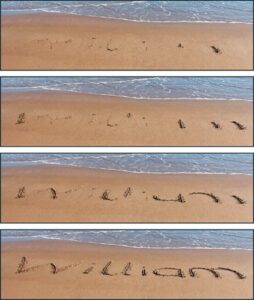 ay morning sermon I gave in Gulf Breeze. I showed a picture of a beach that had some minor, fairly uninteresting marks in the sand (see the top picture in the graphic). If someone told you the waves washing up on shore brought with them some seashells and sticks, which left those marks as the waves receded, would you believe them? I probably would. I could see that happening. Now look at the second picture from the top. Look at those markings. Would you believe the same story? Again, I might. How about the third picture? Now I’m strongly doubting. It just looks too strange to be random scrapes from seashells and sticks. Now, how about the last picture? No way! The random actions of waves will never write the name “William” in the sand. Someone obviously wrote that using some object.
Admittedly, the name “William” is pretty simple. It’s not much of a message. However, it’s still a message and complex enough to lead you to believe it’s not the result of undirected processes of nature.
Alright, let’s shift gears and talk about human biology. The human genome (our DNA) consists of about 3 billion letters and contains an absolutely amazing amount of information, stored in an incredibly compact and efficient format.
Where did that information come from?
Physical materials do a great job of storing information. Consider a book, made of paper and ink. You can store a lot of information that way. How about a flash drive, made of silicon and other materials? It does a MUCH better job of storing information. And then a computer hard drive, similar to a flash drive. It can hold even more information (mainly because it’s larger). In each of these cases, the physical materials do a great job of storing the information. But in none of these cases did those materials CREATE the information! The paper and ink did not write the book; an author did. They just used paper and ink to store what they wrote. The metal and silicon did not write Microsoft Office software; programmers did. They just used those materials to store the information. In each of these cases, you can always trace the information back to an intelligent source. Always!
So now consider DNA. It is also made of physical materials (a phosphate group, deoxyribose sugar, and nitrogen bases). They do an even better job of storing information. Without getting too technical, if you had an amount of DNA equal to something a little smaller than a sugar cube, it could store all the movies ever made! Bad news, you wouldn’t have time to watch them, and someone might drop that cube in their coffee by mistake! 🤣
Again, we ask, where did the information come from? Consider the secular explanation for life and the universe. Everything allegedly began with a “big bang.” Supposedly, the Big Bang initially created mostly hydrogen and helium (and a little bit of lithium), the simplest elements in the periodic table. Those elements consist of electrons, protons, and neutrons. No messages there, just particles. Today, we have myriads of information in living things. So, step me through the process of how we go from particles to astronomical amounts of extremely complex information. We don’t have time or space in this brief article to unpack all this but consider one other thing. To have “information”, you must have an agreed-upon language system, including characters, definitions of “words,” and grammar! However, you also need someone or something to read and properly understand the information, the will or necessity of carrying out any intrinsic instructions, and the necessary tools to do so. How do you move from particles interacting with each other to all of that, one undirected step at a time? Short answer: you don’t!
Conclusion. Messages come from a message sender. Message originators are always intelligent sources. Intelligent sources are not possible without living entities. Living entities are not possible without messages (information). It’s an enormous “chicken and the egg” scenario. Secular scientists have no real answers, but they keep promoting their ideas because they refuse to allow the possibility of an Intelligent Designer. As I’ve said many times, it’s ultimately a heart issue, not an academic debate. They scream, “We’ve all come from undirected processes of nature which itself came from undirected processes within the universe, which ultimately came from nothing!” I say, or more correctly quote, John 1:1-3
In the beginning was the Word, and the Word was with God, and the Word was God. He was in the beginning with God. All things were made through him, and without him was not any thing made that was made.
Interestingly, when you see “Word” in this passage, it is the Greek word “logos,” which means “word, speech, utterance, or message.” Looks like once again, God seems to know what He’s talking about, perhaps because He is the ultimate Master of all time, space, and dimension…\
Ah, Lord God! It is you who have made the heavens and the earth by your great power and by your outstretched arm! Nothing is too hard for you (Jeremiah 32:17).
As always, if you have any questions about this or any other issue, please don’t hesitate to contact us!