
 We’ve got sugar-free, gluten-free, dairy-free, nut-free, sodium-free, you name it. To me, most of those could be labeled as “any reason at all to eat this stuff-free.” I’d rather have free gluten than gluten-free. Oh, I get it. Some of these are the result of trying to offer healthier food options. Some are mainly for people who might have dangerous reactions to certain ingredients. My statements are primarily meant for comic relief and not as serious dietary recommendations. Maybe my statements could be considered “humor-free.” I often tell people how funny I am because many of them just don’t seem to figure that out for themselves. 🤣
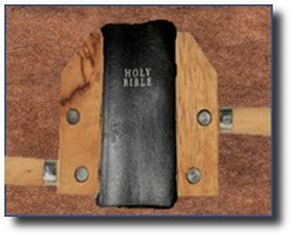
So, what is a “miracle-free” Bible? As you can imagine, it would be one without any miracles. After all, some people react very severely to miracles, so we can’t expose them without some kind of warning label.
Is there really such a thing as a “miracle-free” Bible? Not really, but many people think so, and I used to believe it existed. What led me to believe in such a thing? I heard something repeated enough that I just assumed it was true. It was only recently that I found out it’s not. What did I hear? I heard all about (actually only partially about) the “Jefferson Bible.”
What’s the Jefferson Bible? As you may know, Thomas Jefferson was the third president of the United States. You know, the United States, right? The only country in the world that’s not a foreign country. 😊Thomas Jefferson created something that became known as “The Jefferson Bible.” He titled it (hold on while I take a deep breath), The Philosophy of Jesus of Nazareth Extracted From the Account of His Life and Doctrines as Given by Matthew, Mark, Luke & John; Being an Abridgement of the New Testament for the Use of the Indians Unembarrassed with Matters of Fact or Faith Beyond the Level of Their Comprehensions. You’d almost need an entire book to write out the title!
He selected various passages from four versions of the Gospels, written in English, Greek, French, and Latin. What did he leave out? Well, anything that had to do with miracles, such as the virgin birth and the resurrection. Even Jesus’ Divinity was excluded. Contrary to popular belief today, this wasn’t intended to be a “miracle-free” Bible. His intention was to present the teachings and life of Jesus as a basis for morality, primarily to benefit the Indians, offering them an abridged version of Jesus’ philosophy.
This Question of the Month article isn’t intended to be a defense of Jefferson, but to think about the idea of miracles in general.
Many skeptics object to the idea of miracles. I have two initial questions for them:
- If God exists, can you give me an example of something that would be impossible? Now, if they say they don’t believe God exists, that’s an entirely different conversation. At that point, they don’t have evidence that miracles don’t or can’t happen; it’s just that their adopted belief system (atheism) won’t allow for it, no matter what.
- If miracles don’t happen, exactly how is God supposed to show us evidence of His existence?
Skeptics are quick to say, “Do you really believe that a donkey talked to Balaam? That’s crazy!” Or they might ask a similar question of a snake talking to Eve in the garden. If God does not exist, I would say there’s no way those things happened. However, if God does exist and the Bible is His inspired Word, then even for those things that sound bizarre to me based on my own personal experience, I say, “Yes, I do believe those things happened.” I fully expect God to do things that really catch our attention and go way beyond the ordinary. It’s also interesting to note that many people don’t believe the Bible, but they do believe God exists. They don’t seem to think it’s too hard for God to create an entire universe out of nothing, but somehow there’s no way He could get an animal to talk. There’s a huge disconnect in this logic.
Even some Christians try to explain away the miracles in the Bible by natural processes. I remember, many years ago, seeing a promotion for a video series about many of the major miracles in the Bible. It looked very intriguing, so I purchased it and watched the entire series. It was well-produced but very disappointing! They examined each miracle and attempted to explain how it could have rationally happened. For example, when they discussed the three men being thrown into the burning furnace (Shadrach, Meshach, and Abednego), they explained how sometimes, even in a very hot furnace, some areas are not quite as hot, so maybe that’s where these men were standing. It’s how they survived without being burned. I couldn’t believe what I was seeing and hearing! I thought, “That’s crazy! That’s much harder to believe than a miracle.” I can’t imagine convincing a skeptic of that. Or, that somehow, the wind was blowing just the right way and it parted the Red Sea, allowing the Israelites to cross (on DRY GROUND), but then magically closed when the Egyptian army crossed. And these were Christians trying to explain these things away, not skeptics.
The Bible contains numerous instances in which God clearly performed miracles, showing His mighty power. If pretty much everything can be explained away, then we apparently don’t need God and have no evidence of His existence or involvement in our world. Welcome to the Christian version of atheism.
Our God is a God of miracles. Yes, most of day-to-day life consists of the mundane, which can be fairly easily explained, but that makes it very easy for us to detect His fingerprint during those occasions that are not so mundane!
As always, if you have any questions about this or any other issue, please don’t hesitate to contact us!